
A Simple Trick to Buy Stocks When Markets Fall
March 26, 2026
|
A Simple Trick to Buy Stocks When Markets Fall
March 26, 2026
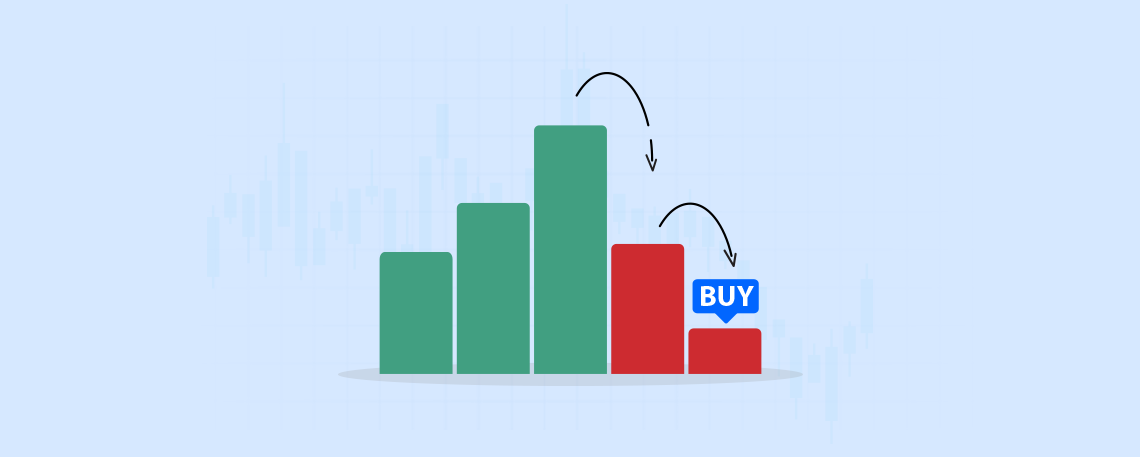
|Every market correction begins with uncertainty. It could be geopolitical tension, disruption in global trade, or concerns around commodities like oil. Whatever the reason, the outcome is usually the same. Markets start declining and confidence starts weakening.
You may notice a stock gradually falling from ₹1,000 to ₹920, then to ₹870, and sometimes even lower over a short period. At the same time, broader indices may correct 5–8% within a few weeks.
What makes this phase difficult is not just the fall in stock prices, but the lack of future clarity. The business itself may not have changed significantly, but the perception around it begins to change. A stock that looked attractive earlier starts feeling uncertain.
This is where most investors struggle, not because they do not understand investing, but because they are forced to take decisions when the sentiments are not good.
Why most investors are unable to act at the right time
There is a common pattern seen during corrections.
When prices are high, investors prefer to wait for better levels. When prices fall, they hesitate again because there is no clarity on how much more the stock can decline.
For example, if a stock falls from ₹1,000 to ₹900, it may already be available at a more reasonable valuation. However, instead of buying, many investors wait because they are concerned that it may fall further to ₹800 or ₹750.
This creates a situation where no decision is taken when the opportunity is available. Later, when the market stabilises and prices start moving up again, confidence returns — but the attractive entry point is no longer available.
The core issue here is not the market movement, but the timing of decision-making.
A simple way to deal with this problem
A more practical approach is to take important decisions in advance, rather than during a correction.
This begins with selecting a business that you understand and are comfortable holding for the long term. The focus should be on the company’s fundamentals. Its earnings, growth potential, and overall strength, not just its current price.
Once the stock is identified, the next step is to decide a price at which you would be comfortable buying it.
For instance, if a stock is currently trading at ₹1,000, you may decide that you would be willing to buy it at ₹800 or ₹750. This is not about predicting the lowest possible price. It is about identifying a level where the valuation becomes attractive from your perspective.
Using GTC and GTD orders to implement this idea
After deciding your buying price, the next step is execution and this is where GTC (Good Till Cancelled) and GTD (Good Till Date) orders become extremely useful.
A GTC or GTD order allows you to place a buy order at your chosen price and keep it active for an extended period.
If you place such an order at ₹800 when the stock is trading at ₹1,000, the system will simply wait. There is no immediate execution. The order remains pending until one of two things happens, either the stock price reaches ₹800, or the validity period ends (in case of GTD).
This is very different from placing a daily order, where you need to track the market and re-enter your order repeatedly. With GTC or GTD, the decision is already made and placed in the system.
What happens when markets correct
If the stock does not fall to your price, nothing happens. Your capital remains available, and there is no unnecessary action. However, if the market corrects and the stock price declines to your level, the order gets executed automatically.
This usually happens during periods when:
- Market sentiment is weak
- News flow is negative
- Many investors are selling their positions
At that point, instead of trying to decide whether it is the right time to buy, your action is already defined. The execution is simply a result of the decision you made earlier.
You may have often heard Warren Buffett’s advice — *“Be greedy when others are fearful.”* It sounds simple, but in reality, it is not easy to follow. When markets are falling, prices are declining, and news flow is negative, it does not feel like the right time to buy. It feels uncomfortable. This is exactly why most investors are unable to act when opportunities are actually available. A practical way to deal with this is to plan in advance. By deciding your buying price earlier and placing GTC or GTD orders, you are not depending on how you feel in that moment. The decision is already made. So when the market corrects and your price is reached, you are automatically doing what most investors only talk about — buying when others are fearful.
A practical way to build your position
Even after defining your buying level, it is not necessary to invest your entire amount at once.
A more practical approach is to build your position gradually.
For example, if you intend to allocate 5% of your portfolio to a particular stock, you may begin by investing 3–4% when your first buying level is reached. If the stock price declines further but the company’s fundamentals remain intact, you still have the flexibility to increase your allocation at lower levels.
From this perspective, a falling price does not always indicate a problem. It can also provide an opportunity to improve your overall purchase price. This approach reduces the pressure of trying to identify the perfect entry point.
The role of research
This entire approach works only when applied to fundamentally strong businesses.
A weak company can continue to decline without recovery, regardless of how attractive the price may appear. On the other hand, a strong business with consistent earnings and demand is more likely to recover over time.
Therefore, the decision to buy should always be based on research and understanding of the business, not just price movement.
Conclusion
Market corrections are an unavoidable part of investing. They create uncertainty, but they also create opportunities. An investor may not be able to control when a correction happens, but it is possible to prepare for it.
By selecting quality businesses, deciding a comfortable buying price in advance, and using GTC or GTD orders to execute that decision, investors can bring discipline to their approach.
Over time, this helps in building a portfolio at more reasonable valuations, without being influenced by short-term market movements.
Stay tuned for more research-driven insights. As a SEBI-registered Research Analyst and Investment Adviser, we are here to guide your long-term investing journey.
Happy investing!















 Continue with Google
  Secure login. No spam.