When the market keeps falling for many weeks, one question comes up in almost every conversation among investors. Is this the bottom? Many people say they will buy stocks only after they are sure the fall is over. This sounds like a safe plan, but it is one of the most costly habits in investing. The Nifty has been falling for a long time in recent weeks, so many investors are asking this question right now. This article uses real data from the Indian market to show why you do not need the answer, and what you can do instead.
Why it is so hard to find the bottom
Nobody likes to buy a stock and see it fall the next day. So we start to think that there is one perfect day to buy, the day of the lowest price, and that smart investors know how to find it. We hear stories of people who bought at the exact bottom. We do not hear from the many people who tried the same thing and failed. This makes the idea look easy when it is not. During a long fall, the market goes up for a few days, and each rise looks like the end of the fall. Then prices go down again, and the people who bought during the rise feel they made a mistake. Later, when you look at the chart, the lowest point looks very clear. But on that day it was not clear at all. At the real bottom, the news is bad, people are afraid, and most investors are selling. That is why the price is low. When the news starts to feel good and safe, the price has usually gone up already. So if you wait until you are sure the fall is over, you often wait until some of the recovery has already happened.
The best days and the worst days come together
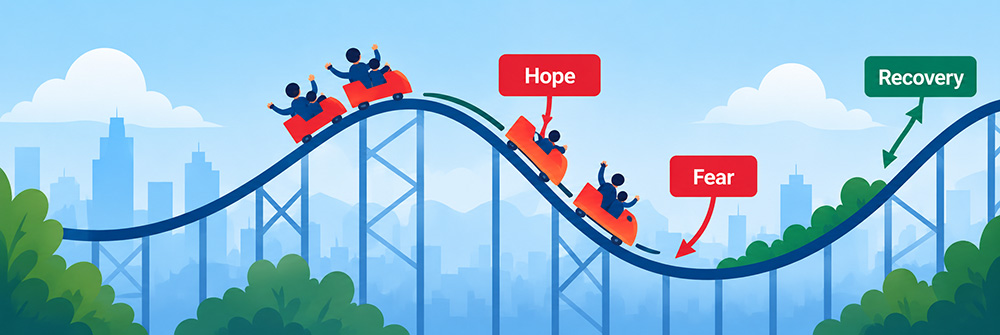
This is the most important fact in this article. The best days in the market usually come in the middle of the worst times. Look at the 10 best trading days of the Nifty 50 in the last 20 years. Out of these 10 days, 7 came within two weeks of one of the 10 worst days. The 2008 crisis shows this very well. Out of the 30 best days since 2005, 22 came during the 2008 crisis. In March and April 2020, during the COVID fall, 4 more of these 30 days came. This means that if you sold your stocks in fear, or stayed out of the market until things felt calm, you were most likely out of the market on the days when it rose the most. The calm came only after those big rises were over.

What you lose if you miss a few days
A few days may sound like a small thing, but the numbers say something different. Suppose you invested ₹10 lakh in the Nifty 50 (with dividends added back) in 2005. By 2025 it would have grown to about ₹1.43 crore if you stayed invested all the time. If you missed only the 10 best days in those 20 years, it would have grown to only about ₹67 lakh. Another study that covers a longer period shows the same thing. If you missed only the 10 best days, ₹10 lakh would have grown to ₹1.3 crore instead of ₹2.9 crore. The loss becomes much bigger when more days are missed. Missing the 20 best days reduces the final amount by 74 percent. Missing the 30 best days reduces it by 85 percent, and missing the 50 best days reduces it by 94 percent. Money grows through compounding, which means your gains also start earning gains. If you are out of the market on a big day, you lose that gain and also all the growth it would have made in the years after. To be fair, you would also earn more if you could avoid the worst days. A study on the US market shows this. But the same study shows that the best days and the worst days come in the same weeks. So if you try to avoid the worst days, you will very often miss the best days too. Nobody has found a reliable way to do one without the other.
Starting at a high price has not been as bad as people fear
Many investors are also afraid to buy when the market is at an all time high. The data shows that this fear is bigger than the real risk. When people invested in the Nifty 50 at an all time high, the average return in the next one year was about 14 percent. This is only an average. It is not a promise for any one investor or any one year. But it shows that the exact day you start matters much less than most people think, as long as you stay invested with a clear plan for a long time.
The index can recover, but your stock may not
There is one important point to understand before you use this data. All the numbers above are about the Nifty 50, which is a group of 50 big companies. An index keeps growing over the years partly because weak companies are removed from it and stronger companies are added. A single stock gets no such help. One company can fall and never come back to its old price. So for a stock investor, the quality of the company matters even more than the day of purchase. A good company bought a little too early still has a good chance to recover. A weak company bought at the exact bottom can keep falling for years. So the better question is not whether this is the bottom. The better question is whether this is a good business and whether the price is fair.
How buying in parts works, with a simple example
Suppose you want to invest ₹50,000 in one stock. Instead of buying it all on one day, you buy ₹10,000 worth every two weeks, five times in total. Now imagine the price is ₹100 at your first purchase. Then it falls to ₹80, then to ₹60, then it rises to ₹80, and at the end it comes back to ₹100. At the first price you get 100 shares. At the second price you get 125 shares. At the third price you get about 167 shares. At the fourth price you get 125 shares, and at the last price you get 100 shares. In total you get about 617 shares for ₹50,000, so your average cost is about ₹81 for each share. When the price comes back to ₹100, your shares are worth about ₹61,670. That is a gain of about 23 percent, even though the price only came back to where it started. If you had bought everything on the first day at ₹100, you would have no gain at all. You did not need to know that the third purchase was the lowest price. This is only an example made to explain the idea. It is not real market data. It also works only if the company stays healthy, because buying more shares of a weak company only increases your loss.
What to do instead of looking for the bottom
The best answer is to stop guessing the bottom and follow a plan based on research. Divide the money you want to put in a stock into three to five parts. Buy the first part now and the other parts over the next few weeks. If the price falls more, your next part buys at a lower price. If the price rises, you already own some shares. Before each purchase, base your decision on research and not on feelings. Check whether the company is still growing its sales and profit, whether its quarterly results are as you expected, and whether the stock is doing better or worse than the market. Write down why you are buying, the price range you are comfortable with, and the point where you will review or sell. Do this when you are calm, so that when fear comes you can follow your own plan and not the latest news. Keep the amount in each stock at a sensible size, and spread your money across several good companies in different sectors, so that one mistake does not hurt your whole portfolio. Also keep your emergency money, and any money you may need in the next two to three years, outside the stock market. When you know you will never be forced to sell, a falling market is much easier to handle. Your aim is to be roughly right and not exactly right. If you buy a good company at a fair price after proper research, and hold it with patience, you can do well without finding the lowest price of the year.
Many investors ask what happens if they buy and the stock falls more. This will happen with some of your purchases. That is why buying in parts is better than buying everything at once, because a further fall gives you a lower price for the next part, as long as the company is still good. If the reason you bought the stock has changed, that is the time to review your decision using the research you did earlier. Some investors ask whether it is better to wait until the market feels stable. But the market usually feels stable only after prices have gone up, and the data above shows that big rises often come in the middle of fear and confusion. A falling price alone is also never a good reason to buy. If the company is weak, if the amount is too large for you, or if you may need the money soon, it is better to wait.
This article does not say that you should invest all your money today, and it does not say that every stock will recover. The data shows what happened in the past. It does not promise what will happen in the future. Every investment in the stock market has risk, and you can lose money. The message here is simple. Perfect timing is not possible, and you do not need it.
Trying to catch the exact bottom feels safe, but it has its own risk. The best days of the market come very close to the worst days, and missing only ten of them can cut your final wealth by more than half. A better way is to choose good companies through proper research, buy in parts, keep each position at a sensible size, keep your emergency money safe, and use research to decide when to review or sell. You will not buy at the lowest price, but you will be invested when the recovery comes. That is what builds wealth over the years.