When a listed company announces that its board will meet to consider a fund raising plan, the stock often moves before anyone knows the details. One public sector bank saw its stock jump more than 2 percent on the day it said its board would meet to consider such a plan. In many of these cases the route chosen is a QIP, short for Qualified Institutions Placement. At least six listed companies opened a QIP between early August and early October 2026 and filed their floor prices with the stock exchanges. If you own shares in a company that announces one, you need to know what a QIP is, why the company chose it, and what it can mean for your holding. This article explains all three in simple words and gives you a checklist you can use.
What a QIP is
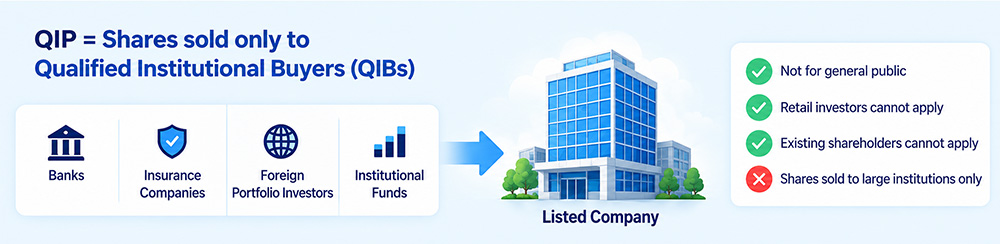
A QIP is a private placement of equity shares or eligible convertible securities by a listed company, made only to Qualified Institutional Buyers, under Chapter VI of the SEBI ICDR Regulations, 2018. Qualified Institutional Buyers, or QIBs, are large institutions such as banks, insurance companies and foreign portfolio investors. The key point is that the shares are not offered to the general public. Retail investors and existing shareholders cannot apply, and the company sells new shares to a small group of large institutions at a price set within rules laid down by SEBI. The company files a placement document with the stock exchanges, which you can read on the NSE and BSE websites under corporate announcements.
How the price is set
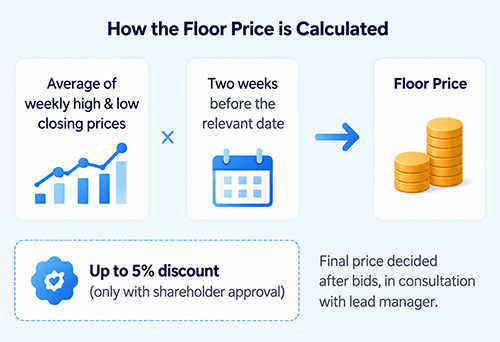
SEBI does not let the company choose any price it likes. The ICDR rules give a formula for a floor price, which is based on the average of the weekly high and low closing prices of the stock over the two weeks before a date called the relevant date, normally the day the board or its committee decides to open the issue. The company may offer a discount of up to 5 percent on this floor price, but only if its shareholders have approved it through a special resolution. You can see this in recent filings. In one QIP this year, the indicative issue price was about 4.5 percent below the last closing price of the stock. The final price is decided after the bids come in, in consultation with the lead manager, so the price you see at the start is only the lowest price allowed and not the price the institutions finally pay.
Why companies choose a QIP
The main reason is speed. A follow on public offer or a rights issue takes much longer, because it needs a full offer document, wider marketing and a longer timetable. A QIP can be completed in a matter of days once the approvals are in place, which lets a company raise money when market conditions are favourable and before they change. A second reason is cost, because a placement to a small number of institutions needs less paperwork and marketing than an offer to the public. A third reason is that the money comes as equity, so it does not add to the debt of the company. This matters for a company with a heavy debt burden, and for a bank that has to meet capital requirements. The fourth reason is the quality of the buyers. A QIP brings large, research driven institutions into the shareholder list, and some companies value this because it can improve the standing of the stock in the market.
The uses of the money fall into a few groups. Some companies raise money to repay debt and reduce their interest cost. Some raise it for new factories, new capacity or new products. Some use it for acquisitions, some for working capital, and banks and finance companies often raise it to strengthen their capital base so that they can lend more. Many placement documents also list general corporate purposes as a use, and since this phrase is very broad, it tells you the least. Timing can differ from approval. A company usually takes shareholder approval for an enabling amount first and launches the issue later. One company received its shareholders approval in December 2025 and opened its QIP in August 2026. So an approval at an annual general meeting does not mean that a QIP is coming at once.
What it means for you as a shareholder
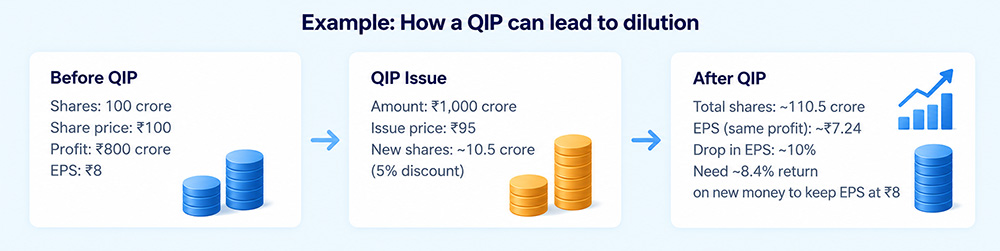
The first effect is dilution: The company issues new shares, so the total number of shares rises, and your holding becomes a smaller percentage of a larger company. A simple example shows the numbers. Suppose a company has 100 crore shares trading at 100 rupees and it earns a profit of 800 crore rupees, so its earnings per share, or EPS, is 8 rupees. It raises 1,000 crore rupees through a QIP at 95 rupees per share, which is a 5 percent discount. It issues about 10.5 crore new shares, and the total rises to about 110.5 crore. A shareholder who owned 1 percent of the company now owns about 0.9 percent. If the profit stayed at 800 crore, the EPS would fall to about 7.24 rupees, a fall of nearly 10 percent. The profit does not stay the same if the money is used well. The company needs to earn about 8.4 percent on the new money for the EPS to stay at 8 rupees, and anything above that raises the EPS. This simple break even number is the most useful way to judge a QIP. A company that can earn a high return on the new capital makes the dilution worthwhile, and a company that cannot is only spreading the same profit over more shares.
The second effect is on the price: Because the shares are sold at a discount, the stock can come under pressure when the issue opens, since the institutions buying in the QIP may hold shares that are priced below the market. The reaction is not always negative. A stock can rise if the market believes that the new money will strengthen the balance sheet or fund profitable growth, or if well-known institutions with a long term record take a large part of the issue. The same fund raising can be seen as good news in one company and bad news in another, and the difference lies in the purpose and in the quality of the business.
The third effect is the supply of shares in the market: Shares allotted in a QIP are locked in for one year, except that they can be sold on the stock exchange. This means that the allottees are free to sell their shares on the exchange at any time, so a large allotment can add to the selling pressure later if the buyers choose to book profit. Companies also agree to a lock up on themselves. In one recent issue, the company accepted a lock up of 90 days after the placement, which stops it from issuing more shares in that period.
The fourth effect is on ownership: The promoters do not take part in a QIP, so their percentage holding falls as new shares are issued, and the public shareholding rises. The shareholding pattern that the company files every quarter will show the new institutional holders. The names of the allottees and their post issue holding percentage are disclosed in the placement document, so you can see which institutions bought and how much.
How a QIP differs from other ways of raising equity
| Route | Who can subscribe | Speed | Effect on existing shareholders |
|---|---|---|---|
| QIP | Only qualified institutions | Fast | Diluted, and cannot take part |
| Rights issue | Existing shareholders | Slower | Can subscribe to avoid dilution |
| Follow on public offer | Public and institutions | Slowest | Diluted, but can apply |
| Preferential allotment | Chosen investors, often promoters | Moderate | Diluted, price rules apply |
For a small shareholder, the main difference is that a rights issue lets you protect your percentage by subscribing, while a QIP does not.
A checklist for judging a QIP
Start with the purpose, and read the section on the object of the issue in the placement document. Debt reduction and a specific expansion plan are clearer than general corporate purposes. Then look at the size of the issue compared with the market value of the company. A raise of 3 percent of market value is a small matter, while a raise of 25 percent is a big change in the share count. Check the discount to the market price and compare it with the discount in other recent QIPs. Check who bought, because a long list of well known, long term institutions is a better sign than a few unknown names. Ask whether the company can earn more than the breakeven return on the new money, using its past return on capital and the plan in the document. Look at the track record, which means how the company used money it raised before and whether it met the promises. After the issue, check the quarterly filings, where companies have to report how the money is being used, and larger issues usually also have an independent agency that monitors the use of funds. Finally, look at the valuation after the news. A good use of funds does not make a stock cheap if the price has already gone up.
Mistakes to avoid
The first mistake is to treat a fund raising announcement as only good news or only bad news without reading the purpose. The second is to look only at the amount and to ignore the size compared with the company. The third is to forget dilution, since a stock can look cheap on its old EPS and expensive on the new one. The fourth is to ignore the general corporate purposes label and not ask for the details. The fifth is to assume that the interest of the big institutions guarantees success, since institutions can also be wrong or can sell after a short time. The sixth is to buy a stock only because a QIP is coming, in the belief that institutions will push the price up. A QIP is one event in the life of a company, and your research on the business, the earnings and the valuation should still decide your decision. This article is for education and is not a recommendation to buy or sell any stock, and every stock market investment carries risk.
A QIP is a quick and low cost way for a listed company to raise equity from large institutions, and it is one of the most common ways to do so in India. For shareholders, it means more shares in the market, a smaller percentage for each of them and a new group of institutional holders. Whether this is good or bad depends on what the company does with the money. If it earns a return above the breakeven level, the dilution pays for itself, and if not, existing shareholders carry the cost. Read the placement document, check the purpose, the size, the price and the buyers, and follow the use of funds in the quarterly results, and you will be able to judge each QIP on facts and not on the headline.