When you apply for an IPO, you usually think that your money will help the company grow. For a large number of IPOs, a big part of the money goes to the lenders of the company instead. A study of more than 200 SEBI filings, reported in December 2025, found that repaying debt was the largest use of money raised through fresh equity issues, at 29 percent, or ₹34,441 crore, ahead of capital expenditure. The largest issue in the news right now follows the same pattern. It is an entirely fresh issue of ₹30,213 crore, and up to ₹27,500 crore, about 91 percent of the gross proceeds at the upper price band, is meant to repay or prepay borrowings of a material subsidiary. This article explains what it means when IPO money goes to repay debt, when it helps a new shareholder, when it does not, and what to check in the red herring prospectus before you apply.
How the money moves
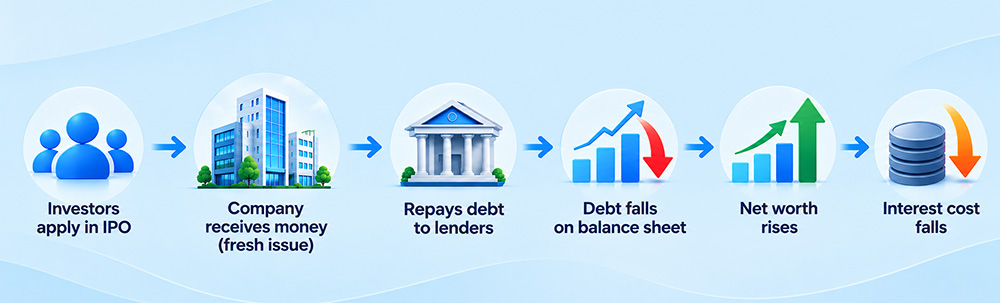
In a fresh issue, the company creates new shares and sells them to investors. The cash comes into the company, and the company then uses it for the purposes listed in the prospectus under the heading objects of the issue. When one of the objects is the repayment of borrowings, the company pays the money to its lenders, which can be banks, bondholders, financial institutions or sometimes group companies and promoters. After the payment, the debt on the balance sheet falls, the net worth rises because of the new equity, and the interest the company has to pay each year falls. The number of shares also rises, so existing shareholders and new shareholders own a business with less debt but spread over more shares. This is a different kind of IPO from one with a large offer for sale, where existing shareholders sell and the company receives nothing. Offers for sale have historically made up a large part of IPO fund raising in India, about 60 percent in 2024 and 63 percent in 2025. A fresh issue that repays debt at least puts the money inside the company, but it is still not money for growth.
Why companies choose to repay debt with IPO money
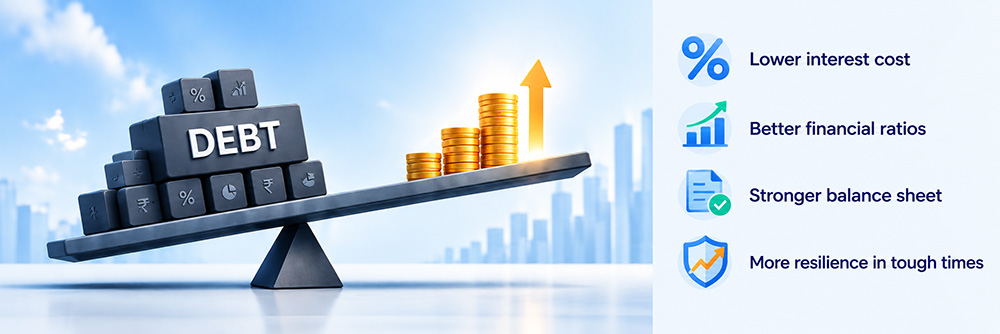
Companies that go public are often carrying a lot of debt, because they borrowed heavily to build plants, networks or stores in earlier years, or because private investors used loans to fund the business. The IPO gives them access to a large amount of equity at once. Using it to repay debt lowers the interest bill, which raises profit after interest, and it improves ratios that lenders and rating agencies look at, such as debt to equity and interest coverage. A company with lower debt is less likely to face trouble if its earnings fall or if interest rates rise, and it can borrow again later on better terms if it needs funds for growth. When interest rates are rising, as they are now, this matters even more. Repayment can also remove loans from group companies or earlier investors, which makes the balance sheet cleaner before the shares trade in the market. These are sound reasons. The question for a new shareholder is whether the repayment creates real value at the price at which the shares are sold.
A worked example of what changes
Take a company with 100 crore shares. Its operating profit, or EBIT, is ₹1,200 crore and its debt is ₹5,000 crore at 10 percent, so the interest is ₹500 crore. The tax rate is 25 percent. The profit before tax is ₹700 crore, the profit after tax is ₹525 crore, and the earnings per share is ₹5.25. The interest coverage, which is EBIT divided by interest, is 2.4 times.
Now suppose the company raises ₹3,000 crore through an IPO at ₹150 per share, which means it issues 20 crore new shares, and it uses the entire amount to repay debt. The debt falls to ₹2,000 crore and the interest falls to ₹200 crore. The profit before tax becomes ₹1,000 crore and the profit after tax becomes ₹750 crore. The shares now number 120 crore, so the earnings per share is ₹6.25, up about 19 percent, and the interest coverage rises to 6 times. In this case, repaying debt improved the earnings per share even after the dilution.
That result depends on the price and the interest rate, so here is a simple test. Compare the after tax cost of the debt that is being repaid with the earnings yield at the issue price, which is the earnings per share divided by the price. In the example, the earnings yield at ₹150 is 3.5 percent, and the after tax cost of the debt is 7.5 percent, so repaying the debt adds to earnings. If the situation is reversed, the effect is reversed.
| Case | Earnings yield at issue price | After tax cost of debt repaid | Effect on EPS |
|---|---|---|---|
| High valuation, costly debt | 3.5 percent | 7.5 percent | EPS rises |
| Low valuation, cheap debt | 10 percent | 6 percent | EPS falls |
Real issues show the same pattern of dilution. In one small issue that planned to repay borrowings, the earnings per share before the IPO was ₹9.15 and after the IPO it was ₹6.63, a fall of about 27 percent. In another, the post issue earnings dilution reduced the earnings per share to ₹0.91 and raised the price to earnings ratio to about 92 times. The first number tells you how much dilution the new shares cause, and the second tells you how much growth the price expects.
The point many investors miss: repaying debt does not create value by itself
It is easy to think that a company that repays debt with IPO money becomes more valuable in the same amount. It does not. Consider a business whose enterprise value, the value of the whole business before debt, is ₹10,000 crore, with debt of ₹3,000 crore and 100 crore shares. The equity is worth ₹7,000 crore, or ₹70 per share. The company issues shares at ₹70 to raise ₹3,000 crore, which takes 42.86 crore new shares, and repays all the debt. The equity is now worth ₹10,000 crore spread over 142.86 crore shares, which is again ₹70 per share. Nothing was created. The new shareholders paid ₹70 and received a share of a debt free business worth ₹70 a share. The benefit comes only if the lower interest cost and the lower risk make the business worth more than before, or if the shares were sold below their true worth. If the shares were sold above it, the new shareholders paid for the cleaning of the balance sheet as well. This is why the issue price matters more than the repayment. One analysis of the largest issue notes that buyers are not buying a share of the money used to repay debt, but a stake in the business at the IPO price, and that a stronger balance sheet does not by itself make an IPO a good investment.
What to check in the red herring prospectus
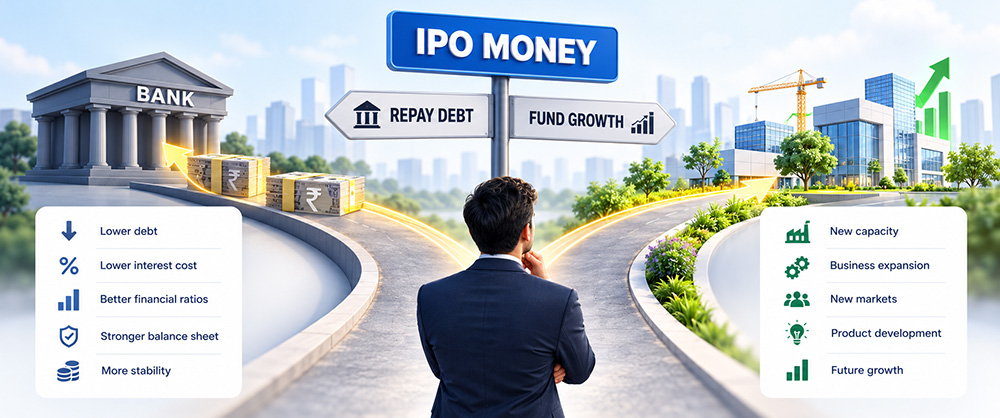
Start with the size of the repayment compared with the whole issue. A repayment that takes 90 percent of the gross proceeds, as in the very large issue, leaves almost nothing for growth, while one that takes a third leaves much more. One recent issue allocated nearly three fourths of its proceeds to debt repayment, and another planned to use ₹1,800 crore of its ₹2,600 crore fresh issue for debt, split between the company and its subsidiaries, with the rest for acquisitions and general purposes. Read the amounts, and then ask what the rest will be used for. A large share under general corporate purposes tells you little, and under the ICDR rules it is usually capped at a share of the issue.
Next, look at which borrowings will be repaid. The prospectus lists the loans, the lenders, the interest rates, the amount outstanding and the date of maturity. Check whether the lenders include promoters, group companies or earlier investors, because in that case the money raised from public investors flows to related parties. Check the interest rate, because repaying a loan that costs 12 percent is far more useful than repaying one that costs 7 percent. Also check whether the loan was in a subsidiary, since in a group structure the debt often sits in a subsidiary and the money must be passed down to it. In the very large issue, the money is meant to repay the borrowings of a material subsidiary.
Then look at the full picture of debt, not only the loans. The company behind the large issue reported net debt of ₹9,539 crore in June 2026, down from ₹39,036 crore a year earlier, but deferred payments and lease liabilities will remain significant even after the repayment. Check the lease liabilities, deferred payments, contingent liabilities, bonds and any pledged assets, along with the net debt to EBITDA ratio and the interest coverage before and after the IPO. Compare these with listed peers.
After that, ask what the company will do for growth. If the IPO gives no money for expansion, how will the company fund its capital spending, and will it borrow again? Look at the operating cash flow, the planned capital expenditure and the free cash flow after repayment. A company that repays debt and then needs to borrow again within a year has not solved the problem. Also check the offer for sale, if there is one. In an issue with both a fresh issue and an offer for sale, part of the money goes to the sellers, so see how much and who the sellers are.
Finally, work out the valuation, using the post issue earnings per share and the price to earnings ratio, and use the test above to see whether the repayment adds to or lowers the earnings per share. Compare the price with listed peers and with the price paid by earlier investors, as we described in our article on reading the prospectus.
What to follow after listing
The prospectus is a plan, and you should check that it is carried out. Companies must report the use of the proceeds, and many file the details of repayments with the exchanges. One filing on the NSE website gives the details of how the IPO proceeds were used to repay borrowings. In one case, a company redeemed a large amount of listed debentures soon after listing, and said that this was done from the IPO proceeds in line with the objects of the issue. In your quarterly review, look at the finance cost in the results. If the debt has fallen but the finance cost has not, ask why. Watch the net debt and whether the company starts to borrow again, and compare the actual interest saving with the saving that the prospectus promised. If the objects of the issue are changed, shareholders must be informed and given a say, so read any such notice carefully.
Questions that investors ask
Is it a bad sign if an IPO is mostly for debt repayment? Not by itself. It can be a healthy step for a company that has grown with borrowed money. It does mean that the IPO is a balance sheet event and not a growth event, so your return has to come from the business and not from the new money. Does lower debt mean the stock will go up? No. A stock moves on earnings, growth and valuation, and a balance sheet that is stronger is one input. Is a company with a lot of cash and low net debt always safe? Not always, since leases, deferred payments and other obligations can still be large.
Mistakes to avoid
The first mistake is to treat debt repayment as if it were money for growth. The second is to ignore the dilution and to look only at the fall in debt. The third is to forget that the shares sold above their worth give the benefit of the repayment to the sellers and the lenders, and not to you. The fourth is to ignore who the lenders are. The fifth is to look only at net debt and to miss the leases and deferred payments. The sixth is to assume that earnings will jump at once, since interest savings come over the next years. The seventh is to ignore the use of the remaining money under general purposes. The eighth is to forget to check the repayment after listing. This article is for education and is not a recommendation to apply for any IPO, and every investment in the stock market carries risk, including the risk of loss of capital.
When IPO money goes to repay debt, the company gets a stronger balance sheet, lower interest costs and less risk, but it gets little new money for growth, and new shareholders take on dilution. The effect on your return depends on the interest rate of the debt that is repaid, on the issue price compared with the value of the business, on who the lenders are and on what the company does after the repayment. Read the objects of the issue, the list of borrowings, the net debt after the issue, the cash flow and the valuation, and follow the filings after listing. A cleaner balance sheet is useful, but you are still buying a business, and the price you pay for it decides most of the outcome.