Let's start with the basics: what do these two terms actually mean?
Imagine you run a small shop.
Revenue is simply the total money that comes into the shop from selling things, before you pay any of your own costs like rent, electricity, or the price you paid to buy the goods in the first place. If your shop sold ₹100 crore worth of goods last year and ₹125 crore this year, your revenue grew by 25%. That is called revenue growth, and it just tells you that more people bought more stuff. It does not tell you anything about whether you actually made more money after your expenses.

Profit margin, often just called margin, is different. It is the percentage of that revenue you keep as profit after paying all your costs. If out of every ₹100 you earn, you keep ₹10 as profit, your margin is 10%. If next year, out of every ₹100 you earn, you manage to keep ₹12, your margin has gone from 10% to 12%. This is called margin expansion. It means the business has become more efficient, not necessarily bigger, but better at holding onto the money it earns.
Here is the key idea this entire article is built on. A company can grow revenue a lot while margin, and therefore actual profit, shrinks. Or it can grow revenue only a little, but improve margin so much that profit shoots up. These are two completely different stories, and right now, in the current earnings season, they are playing out in very different ways across Indian companies.
A real example that proves this point clearly
Let us look at actual numbers from this year, comparing two sectors that reported results in the same quarter, April to June 2026.
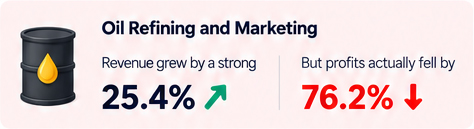

Oil Refining and Marketing companies grew revenue by a strong 25.4%. That sounds great on paper. But profits actually fell by 76.2%.
Building Materials companies grew revenue by a more modest 14.9%. But profits rose by 80.5%.
Pause and really look at that. The sector that grew sales faster ended up with profits that nearly disappeared. The sector that grew sales slower saw profits almost double. Same three months, same broader economy, but completely opposite results, because of what happened to margins, not sales.
Why does this happen? Think about our shop example again. If the cost of the goods you buy to sell suddenly shoots up, but you cannot raise your own selling prices to match, you might still sell a lot more, so revenue looks great, but you are keeping less and less of every rupee. That is roughly what happened to Oil Refining companies. Revenue grew, but rising costs ate into what they kept as profit.
This is why an analysis of 379 large Indian companies, each worth more than ₹1,000 crore, across 13 different sectors for this same quarter, found something surprising. Just knowing how fast a company grew its revenue told you almost nothing about whether profit actually grew. You had to look deeper, at margins, to understand the real story.
Why should you care about this right now specifically?
Because the overall trend is shifting, and understanding why matters for anyone tracking Indian markets this quarter.
ICRA, a ratings agency that studies company and economy trends, expects that for the current quarter, July to September 2026, overall revenue growth for Indian companies will slow down to somewhere between 13% and 15%, compared to a stronger 21.3% in the previous quarter. At the same time, ICRA expects profit margins to stay under pressure, potentially falling by 1 to 1.5 percentage points compared to a year ago. The reason is that raw material, fuel, freight, and packaging costs have been rising.
In simple terms, it is about to become harder for companies to grow sales quickly. At the same time, costs are going up. This combination means margins, not sales growth, are likely to be the bigger factor deciding which companies actually make more profit this quarter.
How different industries are handling this challenge right now
To make this even more concrete, here is how a few different sectors are currently dealing with the trade-off between growing sales and protecting profit.
Metals. Profit is growing much faster than sales.
Across 84 metal companies, sales grew by about 18% on average, but profits grew by 31.7%, almost double the pace. This tells you these companies are not just selling more. They are becoming significantly more efficient at turning each sale into profit. This has caught the attention of foreign investors, who put around ₹6,744 crore into this sector in July and August alone.
Pharma companies. Sales and profit are growing together, in a balanced way.
Pharma companies grew sales by 19.1% and profits by 21.1%, a much smaller gap between the two numbers compared to Metals. This is actually a healthier pattern to look for as an investor. The business is not relying heavily on one factor, like cost cutting, to make up for weakness in the other, like sales. Both are moving up together. It is also why foreign investors put in even more money here, around ₹13,686 crore over July and August, more than any other sector studied.
So, right now, which one actually matters more?
The honest answer is that margin trends matter more right now, but the very best companies are the ones where both are moving in the right direction together.
Here is why margins deserve extra attention specifically in the current environment.
Fast sales growth is becoming harder to find. With overall growth expected to slow down this quarter, companies cannot rely as easily on more customers and more sales to boost their numbers. In this kind of environment, how well a company manages its costs becomes the deciding factor for actual profit.
Rising costs are the main challenge companies face right now, not weak demand. Since raw materials, fuel, and transport costs are all going up, the companies that succeed will be the ones that manage those costs well or find ways to pass them on to customers, and that shows up in margin numbers, not in how much they are selling.
Fast revenue growth without margin discipline can actually be a warning sign, not a good sign. The Oil Refining example is the clearest proof. Revenue up sharply, profit down sharply. A company can be growing while actually becoming less valuable to shareholders if costs are growing even faster than sales.
But margin improvement alone has limits too. A company can only cut costs so far before there is nothing left to cut. This is why a combination of solid revenue growth with disciplined margin gains is often considered a more sustainable kind of success than a margin story built purely on cost cutting.
A simple checklist for reading any company's results
The next time you look at a company's quarterly results, do not stop at the "revenue grew by X%" headline. Ask these questions, in this order.
Did margin go up, stay flat, or go down, both compared to last year and compared to the previous quarter?
Did revenue growth actually turn into profit growth, or did rising costs eat it up? If sales are up 20% or more but profit is flat or falling, that is worth digging into before getting excited.
Is the margin improvement from a real, ongoing efficiency gain, or just a onetime saving? A company that is guiding toward a specific margin target and backing it with sequential improvement quarter after quarter, is showing a far more trustworthy pattern than a company with just one unusually good quarter.
How does this compare to similar companies in the same sector? Metals and Pharma both did well this quarter, but for different reasons. One relied mainly on better margins, the other on a healthy balance of both. Knowing which kind of story you are investing in changes the kind of risk you are taking.
In simple words
Right now, a company's ability to protect and grow its profit margin matters more than just how fast sales are growing. The Oil Refining example, where fast sales growth came with a profit crash, makes that clear. But the strongest, most reliable investments tend to be companies like the ones where healthy sales growth and improving margins are happening together. As an investor, do not stop reading at the revenue number on the first page of a results report. The real story is almost always a little further down, in the margins.