When a very large IPO is in the news, almost every number you see comes from a website, a social media or a message forwarded in a group, and very little comes from the company itself. The official source is a document called the Red Herring Prospectus, or RHP. It runs to several hundred pages, and for a mega IPO it can run to many more, so most investors never open it. You do not need to read every page. You need to know which sections matter, what to look for in each, and which numbers to compare.
Start by using the right document
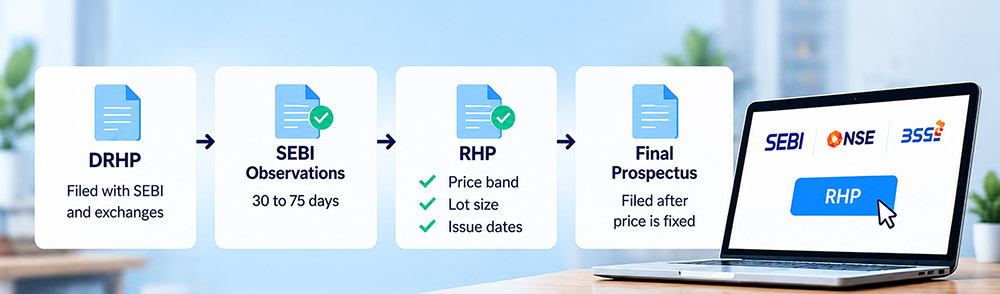
An IPO has three stages of paperwork. First, the company files a Draft Red Herring Prospectus, or DRHP, with SEBI and the exchanges. SEBI typically takes 30 to 75 days to issue its observations on a DRHP. After this, the company files the RHP, which carries the price band, the lot size and the dates of the issue. When the issue closes and the price is fixed, the final prospectus is filed. The price band and the minimum bid lot are published in national and regional newspapers at least two working days before the issue opens. Treat any figure that does not come from the RHP, the exchange notice or the company announcement as unconfirmed. You can find the RHP on the websites of SEBI, the NSE and the BSE, on the website of the company, and on the websites of the lead managers.
Read the summary of the offer first
The first pages of the RHP carry a summary of the offer, and this is where you should begin. It tells you the size of the issue, the number of shares, the price band and the lot size, and how the shares are divided among qualified institutional buyers, non-institutional investors and retail investors. Under the standard split, a large share goes to institutions, and retail investors usually get at least about one third, but check the exact figures in the document, because some issues reserve part of the shares for employees or for the shareholders of a parent company. The summary also names the lead managers and the registrar, and gives the timetable. The shares are required to list within three working days of the close of the issue, a timeline known as T+3. The most important line in the summary is the split between a fresh issue and an offer for sale. In a fresh issue, the company issues new shares and receives the money. In an offer for sale, existing shareholders sell their shares and the money goes to them, not to the company. The very large issue in the news is described as a fresh issue only, with no offer for sale. A fresh issue adds capital to the business, but it also adds new shares and dilutes existing holders. An offer for sale gives no money to the business, so you should ask who is selling and why.
Objects of the issue: where the money will go
This section tells you what the company will do with the money from the fresh issue, and it deserves careful reading. Money used for building capacity, developing new products or buying a business adds to the earning power of the company. Money used to repay debt improves the balance sheet and reduces the interest cost, but it does not by itself create growth. In the very large issue now in the news, the draft papers propose to use up to ₹27,000 crore to repay debt at a group company. Whether that is good for a new shareholder depends on the interest rate on the debt, how the saved interest compares with the new equity issued, and whether the borrowing was spent on assets that earn a return. Also look at the amount set aside for general corporate purposes. Under the ICDR rules, it is usually capped at a share of the issue size, but the phrase is broad and tells you little, so a high share under this head is a reason to ask more questions. Larger issues usually have a monitoring agency that tracks the use of the money, and the company must report on the use of the funds in its quarterly filings after listing, as we described in our article on QIPs.

The business and the industry
Read the sections on the business to answer a simple question. How does this company make money, from whom and against which competitors? Look at the segments, the customers, the geographies, the share of revenue from the largest customers and the key operating measures that the company chooses to highlight. For a mega IPO, the company is often a large group with several lines of business, so see which one produces most of the revenue and most of the profit. The industry section is usually based on a report that the company commissioned from an outside firm, so read it for background and context, and remember that it was paid for by the issuer. Compare the growth claims in the industry report with the actual growth in the financial statements. If a company says that its market is growing fast but its own revenue is growing slowly, the gap deserves an explanation.
The financial information
The RHP gives restated financial statements for the last three financial years and for the latest part year, usually on a consolidated basis. Restated means that the numbers have been adjusted to make the years comparable, so read the notes on adjustments and any qualifications by the auditor. Apply the same checks that you use for a quarterly result. Look at revenue growth, preferably split by segment, then the operating margin and its trend, then profit after tax, and compare how they move together. Check other income, since it can make profit look better than the business is. Compare profit with cash flow from operations, because a company with growing profit and weak cash flow may be selling on credit or tying up money in stock. Look at total borrowings, the interest cost and the interest coverage, which is the operating profit divided by the interest paid. Look at capital expenditure, contingent liabilities and the return on capital. For a company with a large investment programme, check whether the earnings have started to rise as the spending rises. A mega IPO is often compared with its listed peers on revenue size alone, but the quality of earnings, the debt and the cash flow tell you more about the risk.

Basis for issue price: how the price is justified
This section explains how the company and its bankers arrived at the price band, and it is the part that links the business to the price. It shows valuation measures such as the price to earnings ratio, the price to book value and the enterprise value to EBITDA, and compares them with a group of listed peers. Three questions help here. Are the peers truly comparable in business, size and growth, or have they been picked to make the price look reasonable? Is the valuation based on the latest earnings or on an adjusted figure? And is the multiple justified by the growth and the return on capital? The document also discloses the prices at which promoters and earlier investors bought shares in recent periods, including the weighted average cost of acquisition. If promoters bought at a very low price and a pre IPO investor bought at a much higher price a year earlier, compare both with the IPO price. A simple example shows why. If the upper end of the price band is ₹100, the promoters paid an average of ₹20, and a pre IPO investor paid ₹70 last year, then new investors are paying five times the average cost of the promoters and about 43 percent more than the pre IPO investor. That does not mean the price is wrong, but it shows how much of the gain has already gone to earlier holders.
Capital structure, lock ins and the supply of shares
The section on capital structure shows the shareholding before and after the issue, and it tells you who will own the company after listing. Pay attention to two things. The first is how much of the company is offered to the public. In some very large issues, only a few percent of the company is offered, and the special rules for large companies allow them to reach the required public shareholding over a number of years, so further supply of shares can come later through other offerings. A small free float can make the price swing sharply in the early days. The second is the lock in schedule, which controls when existing holders can sell. The promoters minimum contribution of 20 percent is locked in for 18 months, the rest of the promoter holding for 6 months, and the shares of pre IPO investors for 6 months. For anchor investors, half of the allotted shares are locked in for 30 days and the other half for 90 days. These periods are counted from the date of allotment, not from the date of listing. Anchor investors are qualified institutions that bid the day before the issue opens, and up to 60 percent of the institutional portion can go to them. Note the dates on which these lock ins end, because large numbers of shares may become free to sell on those days, and this can add selling pressure. Also look at who the anchor investors are. A long list of well known, long term institutions is a stronger sign than a list of unfamiliar names, though it is still not a guarantee of anything.
Risk factors, litigation and related party transactions
The risk factors section is long, and much of it is general language that appears in every prospectus. Skip the standard items and look for the ones that are specific to this company, usually placed near the top. Look for dependence on a few customers, a single licence or a single supplier, heavy debt, large capital needs, regulatory changes, technology change and any history of losses. Then read the section on outstanding litigation and regulatory actions, especially tax disputes, regulatory proceedings and cases involving promoters and directors, and compare the amounts with the net worth of the company. Next, read the related party transactions. In a large group, a company often buys from, sells to and borrows from other group entities. Check the size of these transactions, whether they are on commercial terms, and whether the IPO will increase or reduce such dealings. Also read about the promoters, the board, the independent directors, the auditors, and any past change of auditors. Weak governance is hard to see in the numbers and it is better to find it before you apply than after listing.
What the prospectus does not tell you
The RHP is a legal disclosure, written to inform and also to protect the issuer, so it does not give you a view on whether the price is attractive. It does not give you the grey market premium, which is unofficial and can change quickly, as we explained in our article on GMP. It does not predict the listing price or the long term return. A big name, a big issue size and a large subscription do not make an IPO safe. Subscription numbers show demand during the bidding days, and the price later depends on the earnings, the valuation and the market. You must form the view yourself, using the document, your own research and your own plan.
Mistakes to avoid
The first mistake is to use a price band or a date from a website without checking the RHP. The second is to rely on the grey market premium. The third is to ignore whether the issue is a fresh issue or an offer for sale. The fourth is to skip the objects of the issue, especially when a large part goes to repay debt or to general purposes. The fifth is to judge the company by its size and fame and not by its cash flow, debt and valuation. The sixth is to compare only with the peers that make the price look cheap. The seventh is to ignore the lock in dates and the supply of shares that follows. The eighth is to apply without a plan for what you will do on listing day. This article is for education and is not a recommendation to apply for any IPO, and every investment in the stock market carries risk, including the risk of loss of capital.
A mega IPO looks complicated because the document is large, but the questions are the same as for any company. What does it do, how well does it earn, how much does it owe, what will it do with the money, how is the price justified, and who can sell the shares and when? The RHP answers all of these, and the summary of the offer, the objects of the issue, the financials, the basis for issue price, the capital structure and the risk and related party sections give you most of the picture. Use the document and not the headlines, compare the price with the quality of the business, and decide on your plan before the issue opens.