Once IPO shares reach your demat account, one question follows. Do you sell, or do you hold? Many investors decide on the morning of the listing, when excitement is high, and regret the decision later. If you were allotted shares in a recent IPO, you now face a question that every allottee faces. Do you sell on the listing day, or do you hold? Similar questions come up with every IPO, so this article gives you a method that you can use each time, and not only an opinion about one issue. The method is simple, and it works best if you decide before the listing day, when your head is calm.
What the numbers say about life after listing
Before the framework, look at the evidence, because it shows why a plan matters. In FY26, 71 of the 108 mainboard IPOs were trading below their issue price at the end of the year, and about 32 of those 71 had actually listed at a premium before they fell below the issue price. A good first day did not protect allottees from a later loss. At the same time, the winners were real. The data reported in February 2026 showed that nearly half of the companies that went public in the previous six years were still below their issue price, yet 57 were trading more than 100 percent above it, and many of the stocks well below their issue price had seen heavy demand during the offer. The reasons given for post listing falls include aggressive pricing that leaves no upside, large offers for sale, weak market sentiment and selling by early investors once their lock in ends. Figures differ by source and period, so treat them as a broad picture and not as exact numbers. The message is that heavy subscription and a strong listing do not decide the long term result. The business, the price you pay and the supply of shares do.
First, know why you applied
Allottees are not all the same. Some apply to earn a gain at listing and sell soon after. Others apply because they want to own the business for years. Both are legitimate, but problems begin when the two get mixed up. An investor who applied for a quick gain, sees the stock fall and says that it is a long term investment, has changed the purpose after the result. An investor who planned to hold for years, sees a 20 percent gain, and sells in excitement has done the opposite. Before the listing, write down one sentence on why you applied, how long you plan to hold and how much of your portfolio this holding represents. This sentence is the base for everything below.
How the listing day works, so that nothing surprises you
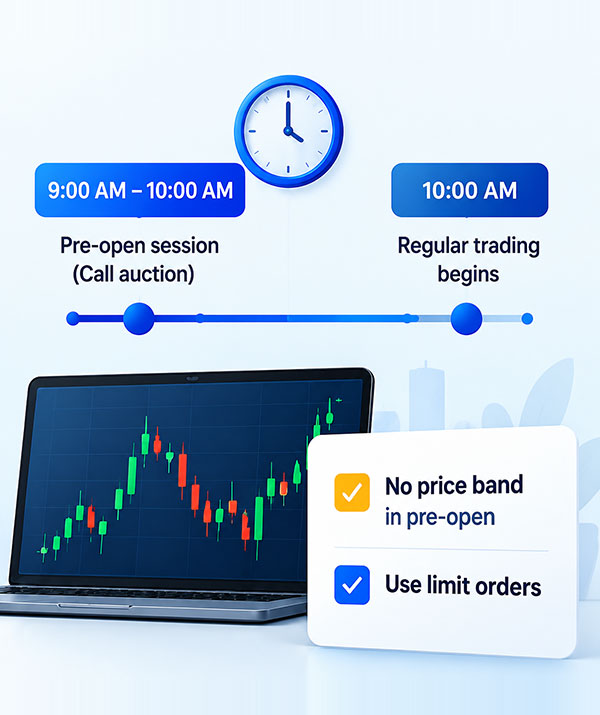
On the day of listing, the stock does not begin to trade at once. The exchanges run a special pre-open session from 9:00 AM to 10:00 AM, which is a call auction that discovers the opening price, and regular trading starts only after it ends. The listing price is set by matching the buy and sell orders in this session, not by the company, the lead managers or the exchange. No price band applies in the special pre-open session, so the first price can be well above or well below the issue price. After the price is found, normal trading begins at 10:00 AM. For an issue larger than ₹250 crore, a circuit limit of 20 percent applies, and for issues up to ₹250 crore the limit is 5 percent, with trading in the trade for trade segment for the first 10 days. If no equilibrium price is found in the call auction, the band is based on 20 percent of the issue price for the larger issues. One practical point matters for allottees. You cannot sell shares that are not yet credited to your demat account, even if the stock has already listed. Check your holdings the evening before listing. Also use limit orders and not market orders in the pre-open session and in the first minutes, because the price can move quickly and a market order can fill far from what you expect.
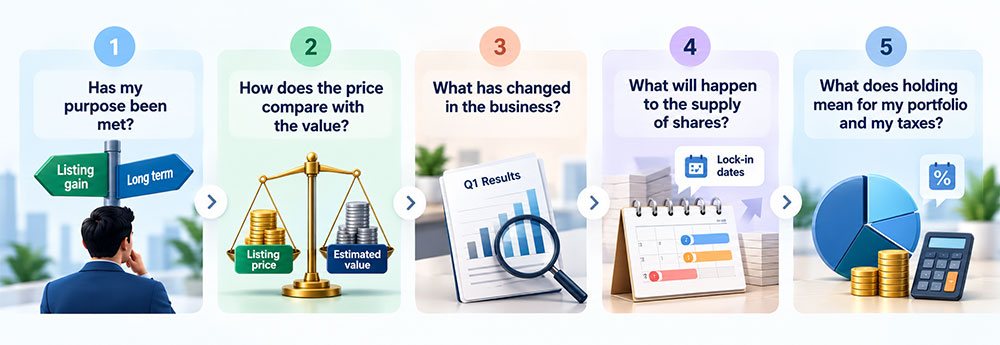
The framework: five questions in order
Question one: has my purpose been met? Look at the sentence that you wrote. If you applied for a listing gain and the gain is at or above the target you set, your plan says that the job is done, and selling all or part follows from your own rule. If you applied to hold for the long term, a high or low listing price does not change the purpose, but it changes the next question.
Question two: how does the price compare with the value? The listing price is a number set by demand on one morning. Compare it with what you thought the business was worth when you applied. Use the basis for issue price in the prospectus, the valuation compared with listed peers and the earnings growth that the price assumes. If the stock lists far above your estimate of value, you are now paying more than you planned for the same business, and the room for further gain is smaller. If it lists below the issue price, the price may be better, but only if the business is unchanged. Do not use the issue price as the reference. The market does not know what you paid, which is the same lesson as in our article on anchoring bias.
Question three: what has changed in the business since the prospectus? A listed company starts reporting results, and the first results and the first call with analysts are your first fresh evidence. Check whether the revenue, margin and cash flow match the picture in the prospectus, whether management is doing what it said about the use of the money, and what it says about the coming quarters. Good news for the business is a reason to keep holding even if the price moves down for a while. A change that breaks the case on which you applied, such as weak guidance, a governance issue or a large unexpected cost, is a reason to review the position whatever the price.
Question four: what will happen to the supply of shares? Many IPO stocks come under pressure when shares that were locked in become free to sell. Promoters keep their minimum contribution locked in for 18 months, the rest of their holding for 6 months, and pre IPO investors for 6 months. For anchor investors, half the shares are locked in for 30 days and the other half for 90 days. If allotment is on October 26, the first half of the anchor shares can be sold from about November 25 and the second half from about January 24, 2027. These are my own approximate calculations, so check the exact dates in the prospectus and the exchange notices. Put these dates in your calendar, and ask whether you want to hold through them. A stock can fall around a lock in expiry even when the business is fine, because a large block of shares can come to the market.
Question five: what does holding mean for my portfolio and my taxes? Look at the size of the position as a share of your total portfolio. A small allotment is a small risk, but a large allotment, or a listing gain that makes the stock a much bigger part of your portfolio, may need trimming for the sake of balance. Also remember that gains on shares held for up to 12 months are taxed as short term gains and those on shares held for longer are taxed as long term gains, at rates that can differ, so check the rules in force and the effect of selling now against selling later. Brokerage, taxes and the loss of other opportunities for your money are real costs of both actions.
A table to connect the questions to actions
| Situation | What the framework points to |
|---|---|
| Listing gain above your target, valuation stretched, purpose was a listing gain | Your plan already says to sell all or most of the shares |
| Listing gain above your target, but the long term case is strong | Consider selling part to lock in the gain and holding the rest with a review date |
| Listing near the issue price, business sound, purpose was long term | Hold as planned, and review after the first results and before the lock in dates |
| Listing below the issue price, no change in the business | Do not sell only to avoid regret, review the case, wait for the first results, and do not average down without new research |
| Listing below the issue price, with a clear negative change in the business | The case may be broken, so review an exit and accept the loss if the facts support it |
This table is a way to organise your thinking and is not a recommendation for any stock.
A worked example of a partial sale
Suppose you were allotted 30 shares at an issue price of ₹500, which is ₹15,000. The stock lists at ₹600, a gain of 20 percent, or ₹3,000 on paper. Your plan said that you wanted to hold for the long term but that you would reduce the position if the stock rose more than 15 percent above the issue price, because you wanted to limit the risk. You sell 15 shares at ₹600 and receive ₹9,000, which is 60 percent of your original investment. You still hold 15 shares, which cost you ₹7,500. If the stock falls to ₹450, your remaining shares have lost ₹750 compared with your cost, but your total position is still ahead of where it started. If the stock rises to ₹800, you hold shares worth ₹12,000, plus the cash you took out. Selling part of the shares did not make the rest free, since those 15 shares can still fall in value. What it did was lock in a part of the gain and reduce the amount at risk, in line with your plan. Whether to do this is a personal decision that depends on your goals, and you should never feel that it is the only choice.

The mental traps that cause the most regret
The first trap is anchoring on the issue price, which makes a loss feel like something to be undone and a gain feel like something that must grow. The second is loss aversion, where a fall below the issue price makes you hold on until the price recovers, even though the business has changed. The third is the opposite habit, the disposition effect, where investors sell winners too early to feel the pleasure of a gain, and keep the losers. The third and fourth traps are linked to buying more shares in the market after a big listing day rise because of the fear of missing out, which means that you pay the high price that the allotment gave you the chance to avoid. The fifth trap is treating the profit as free money and taking larger risks with it. Each of these is a reaction to the price and not a decision about the business, and a written plan is the best protection against them.
Build your plan before the listing day
A simple plan has four parts. First, a rule for the listing day, for example that you will sell a stated share of your shares if the price is above a level you have set, and nothing if it is below. Second, review dates, including the date of the first results, the 30 day and 90 day anchor lock in dates, and the end of the six month lock in for pre IPO investors. Third, a level or an event at which you will review the holding, such as a fall of a stated percentage below the issue price or a negative change in guidance. Review does not mean selling automatically. It means that you stop and apply the five questions. Fourth, a note on how you will record the result, so that you can learn from each IPO, whether it was a gain or a loss. Keep the plan short, and keep it where you will see it.
Mistakes to avoid
The first mistake is to decide on the morning of the listing instead of before it. The second is to use a market order in the pre-open session. The third is to try to sell before the shares are credited to your demat account. The fourth is to judge the company by the listing price and not by its business. The fifth is to ignore the lock in expiry dates. The sixth is to average down in a falling IPO stock without any new research. The seventh is to forget the tax and cost of selling. The eighth is to treat strong subscription as proof of quality, since many heavily subscribed issues have traded below their issue price later. The ninth is to hold a large position that has grown beyond what your portfolio can carry. This article is for education and is not a recommendation to hold or sell any stock, and every investment in the stock market carries risk, including the risk of loss of capital.
What to do after an IPO allotment is not a question of luck or of reading the first price correctly. It is a question of a plan. Know why you applied, understand how the listing day works, and then ask five questions: has my purpose been met, how does the price compare with the value, what has changed in the business, what will the supply of shares do, and what does the position mean for my portfolio and taxes. Write the answers down before the listing, review at the first results and the lock in dates, and act on your plan instead of the excitement of the day. The data shows that a strong start is no guarantee of a good ending, and that some IPOs go on to reward patient holders, so the way to improve your odds is to decide on facts and on your own plan.