Every quarter, a company reports its numbers, and those numbers are already history. The stock price, however, depends on the earnings the company is expected to make in the coming quarters, and the main source of that information is guidance from the management. The Q2 FY27 results season is on, and in many cases the commentary on the outlook is moving the stock more than the reported revenue and profit. This article explains what guidance is, how to read a raise, a cut or an unchanged outlook, and how to use it in your own research, in the language you will actually hear from analysts and on earnings calls.
What guidance means
Guidance is the view of the management on the future performance of the business, given to investors in the press release, the investor presentation and the earnings call. It can be quantitative, such as a range for revenue growth for the full year, an exit EBIT margin target, a capex plan, a volume growth estimate or a target for the order book. It can also be qualitative, such as a comment that demand is stable, that the pricing environment is improving, or that the recovery is likely to be gradual. SEBI does not require a company to give numerical guidance, so practice differs. Large IT services companies usually give a yearly constant currency revenue growth range. Many companies in other sectors speak only in general terms. For that reason it is worth noticing when a company that normally gives a number stops giving one. Most presentations carry a note that forward looking statements involve risk, which tells you that guidance is an estimate and not a promise. You can read the full discussion in the concall transcript, which the company must file on the NSE and BSE websites within five working days.
Why guidance moves the stock more than the reported numbers
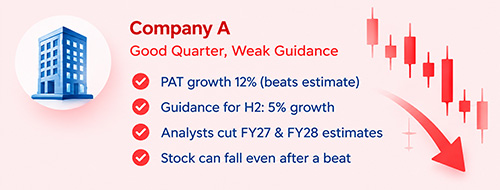
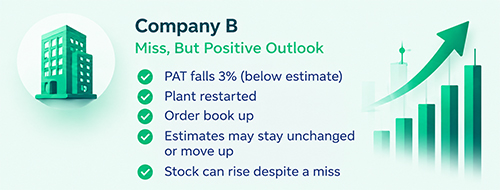
A stock is priced on expected future earnings, which is why the market follows the consensus estimates of analysts for EPS, revenue and margins. When management gives guidance, analysts revise these estimates, and a change in estimates changes the valuation the market is willing to pay. A downward revision in earnings usually leads to a de rating of the stock, and an upward revision can lead to a re-rating. Consider two made up examples. Company A reports PAT growth of 12 percent year on year, ahead of the street estimate, but management guides for growth of only 5 percent in the second half. Analysts cut their FY27 and FY28 EPS estimates, and the stock can fall even after a beat on the quarter. Company B reports a fall in PAT of 3 percent, below estimates, because a large plant was shut for six weeks. Management says the plant has restarted, the order book has grown and margins should normalise next quarter. Estimates may stay unchanged or even move up, and the stock can rise despite a miss. In both cases the price reacted to the outlook, not to the quarter that was just reported.
The ways guidance can change
A guidance raise means that management has more confidence than before, and it is usually positive, but the reason matters. A raise driven by volume growth, new client wins or better realisations reflects a stronger business. A raise driven by a weaker rupee, a one-time gain or a lower tax rate is of lower quality because it may not repeat. A guidance cut means that management sees a weaker outlook than it did earlier. A cut caused by a temporary issue, such as a plant shutdown or a delayed deal, can reverse in a quarter or two. A cut caused by a structural issue, such as lost market share or pressure on pricing, can stay for years.
A maintained guidance also needs a calculation. Suppose a company guided for revenue growth of 8 to 10 percent for the year and the first half grew only 5 percent. If the two halves are about equal in size, the second half would need to grow roughly 11 to 15 percent to reach the guided range. When management maintains the guidance after a weak H1, the whole target depends on a strong H2, which the market calls a back ended or second half weighted year, and this is a common early sign of a later cut. A narrowed range, for example from 2 to 4 percent to 2.5 to 3.5 percent, keeps the midpoint the same and shows higher confidence. If the lower end is raised, the signal is positive. If the upper end is lowered, the signal is mildly negative. Finally, when a company withdraws or stops giving guidance, it means that visibility has fallen, and this calls for more caution than a small cut.
The language you will hear on the call
Guidance comes with terms that are worth knowing. Sequential or QoQ growth compares a quarter with the one just before it, while YoY growth compares it with the same quarter last year, and guidance for the full year is often easier to judge when you look at the sequential run rate. Constant currency growth removes the effect of exchange rate changes, which matters for exporters and IT services companies, since a weaker rupee raises reported revenue even when the business has not grown. Organic growth excludes the effect of acquisitions. Exit margin is the margin the company expects to reach by the end of the year, and it is a target you can test every quarter. Operating leverage means that profit grows faster than revenue when costs are largely fixed. For IT companies, the order book and the total contract value of new deals show future revenue visibility. In manufacturing and consumer businesses, the split between volume growth and realisation, which is the price per unit, shows whether growth comes from selling more or from charging more. When management says that visibility is limited, it means that it cannot see far into the future. Headwinds are factors that hurt the business and tailwinds are factors that help it.
Always ask why
The number alone says little, and the reason behind it says much more. Ask whether the change comes from factors within the control of the company, such as product mix, cost control and capacity, or from external factors, such as commodity prices, interest rates, currency and the demand environment in other countries. Ask whether it is temporary or structural. Ask whether it is company specific or common to the whole sector. If every company in the sector is cutting guidance because of weak demand, the stock may be falling along with its peers, and relative performance among peers becomes the useful measure. If only one company is cutting while its peers raise, something inside that business needs to be understood. Finally, check whether the guidance agrees with the evidence in the quarter. If management speaks of strong growth while the order book, volumes or margins are weakening, the gap needs an explanation.

Reading tone and track record
Management speaks for an hour on the call, and the way it speaks is information. Specific comments, such as the sectors, clients, products and quarters in which improvement is expected, carry more weight than general phrases like "we remain cautiously optimistic." Language that has changed from last quarter, for example from "strong second half" to "gradual improvement," tells you that the view has weakened even if the number has not moved. The answers to analyst questions are as important as the opening remarks. A direct answer to a question on margins or demand is a good sign, and a long answer that avoids the question is a warning. The most useful check is the track record. Go back over the last four to six quarters and note what management guided for and what it delivered. A management that meets or beats its guidance deserves more weight than one that guides high and cuts later.
How the market reacts
New investors often expect that a cut always sends the stock down and a raise always sends it up. The price reacts to the gap between the guidance and what the street had already expected, which is called being priced in. If a cut was widely expected, and the stock had already fallen, a modest cut may cause little reaction or even a relief rally. If the market expected a strong raise and received a small one, the stock can fall on good news. The reaction on the day can also be affected by market direction, FII flows and the valuation of the stock before the result. A one day move is therefore a poor measure of the quality of the guidance. The better measure is the change in estimates over the following weeks, which shows how analysts actually revised their numbers.
How to use guidance in your own research
Before the results, note what management guided for last quarter and what the street expects now. When the results arrive, read the press release and the investor presentation for the outlook, then read the concall transcript, giving special attention to the analyst questions on guidance and to the clarity of the answers. Compare the new guidance with the previous quarter and with the record of the last four quarters. Then decide on research, not on the headline. If you hold the stock, ask whether the thesis on which you bought is still intact after this guidance. A cut from a temporary cause with an unchanged long term thesis is often a reason to review again after the next quarter, while a cut from a structural cause, such as lost share or lasting pressure on pricing, calls for a serious review of the position. If you are planning to buy, it is often more sensible to wait for one more quarter and see whether management delivers on its revised guidance before adding.
Mistakes to avoid
The first mistake is to treat guidance as a commitment. It is an estimate, and management can be wrong. The second is to react to the words raised or cut without reading the reason. The third is to accept the commentary without checking it against data such as the order book, volumes, realisations and costs, because managements usually present the outlook in a positive way. The fourth is to compare guidance across sectors as if it meant the same thing. The fifth is to judge the stock on one quarter, when the trend over several quarters tells you far more.
A result tells you what the business earned, and guidance tells you what management expects it to earn next, which is the number the market is trying to price. A raise, a cut, a maintained range, a narrower range and a withdrawn range each carry a different signal, but the reason behind the change carries the most. Ask what changed, whether it is temporary or structural, whether it affects the whole sector or only this company, and whether management has delivered on its earlier guidance. Read in this way, a few lines on the earnings call become a useful input to your research, not a reason for a hurried reaction.