When a very large company lists on the stock exchange, many investors assume that it will at once become one of the biggest names in the Nifty or the Sensex. Often it does not. A company worth many lakh crore rupees can enter the market with a small weight in the indices, and the reason is a term that most investors never look up, the free float. This article explains what free float is, how index weights are calculated, why a giant new listing can carry a small weight at first, and what this means for how you read the news about large listings and about your own stocks.
Market capitalisation and free float are not the same thing
The market capitalisation of a company is the share price multiplied by the total number of shares. It is the number that you see in headlines when someone says that a company is worth a certain amount. The free float market capitalisation is different. It counts only the shares that are actually available for the public to trade, and it leaves out the shares held by promoters, the government, other strategic holders and shares that are locked in. In simple words, it is the value of the shares held by everyone except the insiders who are not expected to sell. The free float factor is the share of the total shares that falls in this tradable group.
Two simple examples show how much the two numbers can differ. Company X has 100 crore shares trading at ₹1,000, so its market capitalisation is ₹1,00,000 crore. The promoters hold 75 percent, so the free float is 25 percent, and the free float market capitalisation is ₹25,000 crore. Company Y has 100 crore shares trading at ₹500, so its market capitalisation is only ₹50,000 crore. The promoters hold 20 percent, so the free float is 80 percent, and its free float market capitalisation is ₹40,000 crore. Company X is twice as large as Company Y by market capitalisation, but Company Y is much larger by free float market capitalisation. For an index, the second number is the one that counts.

How index weights are calculated
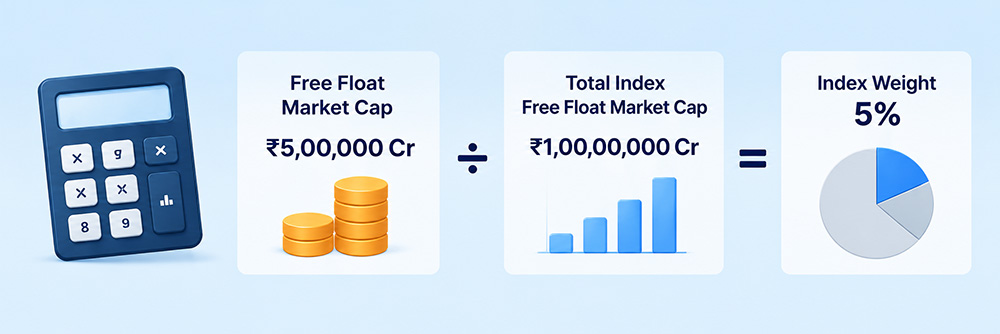
Most major Indian indices, including the Nifty 50, are weighted by free float market capitalisation. The Nifty 50 represents the top 50 listed companies, weighted by free float market capitalisation, and free float market capitalisation is the value of the shares held by everyone except the promoters. The weight of a stock is its free float market capitalisation divided by the total free float market capitalisation of all the stocks in the index. If a stock has a free float market capitalisation of ₹5 lakh crore and the whole index has ₹100 lakh crore, the stock has a weight of 5 percent. This is also why the weights of big, well-known companies in the index differ from what you might guess from their size alone. A company with a large promoter holding gets a smaller weight than a company of the same size that is widely held.
Why a giant new listing can start with a small free float
A company that wants to list has to offer a minimum share of its capital to the public. Until recently, this minimum was 5 percent, even for very large companies. Under the earlier rules, even a 5 percent or 10 percent offer by a very large company could have meant an issue worth tens of billions of dollars, which might have overwhelmed the Indian market. To solve this, the government changed the Securities Contracts (Regulation) Rules in March 2026. Companies with a post issue market capitalisation above ₹5 lakh crore can now offer a minimum of 2.5 percent of their shares to the public when they list. The rule also sets a timetable for increasing the public holding. Such companies must raise the public shareholding to at least 15 percent within five years and to the standard 25 percent within ten years.
This is the reason why a giant listing may be a small event in the index at first. Suppose a company is valued at ₹10 lakh crore after listing and only 2.5 percent of it is available to the public. The free float market capitalisation is ₹25,000 crore, and this is the number that the index provider would use to calculate the weight. For a sense of scale, in the Nifty 50 review of February 2025, the two stocks that were removed had average free float market capitalisations of about ₹60,928 crore and ₹64,151 crore, while the two that entered had ₹1.04 lakh crore and ₹1.70 lakh crore. The ₹10 lakh crore company in this made up example would have a free float market capitalisation well below the level of the smallest members of the index, even though it is far larger than all of them in total value.

A table to see the difference
The table below uses made up numbers. It assumes that the index has a total free float market capitalisation of ₹100 lakh crore, which is a round number chosen for simplicity.
| Company | Total market capitalisation | Free float | Free float market capitalisation | Approximate index weight |
|---|---|---|---|---|
| Giant new listing | ₹10 lakh crore | 2.5 percent | ₹25,000 crore | 0.25 percent |
| Established large company | ₹6 lakh crore | 50 percent | ₹3 lakh crore | 3 percent |
| Mid sized widely held company | ₹1 lakh crore | 75 percent | ₹75,000 crore | 0.75 percent |
The giant company is more than eight times the size of the mid-sized company in total value, but its weight is only about a third of the weight of the mid-sized one. This is the point that surprises many investors. The size of the company and the weight of the company in the index are two different things.
Why entry into the index may not come quickly
Index providers have their own rules for adding a stock. For the Nifty 50, a company needs an average free float market capitalisation of at least 1.5 times that of the smallest constituent, measured over the review period, and the index is rebalanced twice a year. A stock must also be part of the futures and options segment to be eligible. A new listing does not enter the derivatives segment at once. Under the methodology described in market reports on an earlier large spin off, a stock needed at least six months of trading history to qualify for derivatives inclusion. There are special fast entry rules in some indices, but they depend on the size of the free float. One analyst note on a very large recent issue concluded that there would be no index fast entry given the low float. The practical result is that a giant listing with a small float may not enter the main indices for some time, and when it does enter, the buying by investors who track the index is based on the free float and not on the total value of the company.

What happens as the float grows
The low float is not permanent. The glide path says that the public shareholding must grow, and this can happen in several ways, for example through a sale of shares by the promoters, a fresh issue of shares, the end of lock in periods or another placement to institutions. Each increase in the free float raises the weight of the stock in the indices, which means that investors who follow the index have to buy more of it. At the same time, the increase in the float also means more shares for sale in the market, and a large supply can weigh on the price. These two effects pull in opposite directions, and their sizes depend on the timing and on the demand at that moment. The point for an investor is that the supply of shares is not fixed, and the dates of the next increase in float are part of the story.
What this means for you as an investor
First, when you read that a company is the largest or the most valuable in the country, check how much of it is actually available for trading. A large total value and a small float can mean a stock that is large on paper but light in the indices. Second, free float affects liquidity. A stock with a small float has fewer shares available to buy and sell, which can make the price move more sharply on a given amount of buying or selling, although a very large company may still have heavy trading in rupee terms. Look at the average daily traded value and not only at the market capitalisation. Third, the change in free float is a market event. Promoter sales through an offer for sale or a QIP, the expiry of lock in periods and the glide path to a higher public holding all increase the number of shares available, and you can follow them through the shareholding pattern, the filings and the lock in schedule in the prospectus. Fourth, index weights are published by the index providers on their websites, so you can see exactly how much weight a stock carries and how it changes after each review. Fifth, remember that a high index weight does not make a stock a good investment, and a low weight does not make it a poor one. The weight shows how the index is built and says nothing about the value of the business.
A short routine you can follow
When a large company lists or when you want to understand a stock better, check the free float in the shareholding pattern by looking at the promoter and government holdings. Look at the lock in expiry dates and at any commitment to raise the public holding. Check the weight of the stock in the index factsheet and the date of the next index review. Look at the average daily traded value and whether the stock is in the futures and options segment. Then ask how the supply of shares is likely to change over the next year, and put that next to your own research on the business and the valuation.
Mistakes to avoid
The first mistake is to treat market capitalisation and index weight as the same thing. The second is to assume that a giant listing will immediately attract large buying from investors who follow the index. The third is to forget that the float will rise over the years and that this brings new supply. The fourth is to assume that a small float must push the price up. The fifth is to judge the value of a company by its listing day size. The sixth is to ignore the lock in dates and the glide path. The seventh is to ignore liquidity. This article is for education and is not a recommendation to buy or sell any stock, and every investment in the stock market carries risk, including the risk of loss of capital.
An index does not count the whole company. It counts the part that the public can trade, which is the free float. This is why a giant new listing can start with a small weight, even though its total value is very large, and why it may take time to enter the main indices. The rules now allow the very largest companies to list with a free float of only 2.5 percent, with a plan to raise it to 15 percent in five years and 25 percent in ten years. Understanding the difference between market capitalisation and free float market capitalisation helps you read the headlines about big listings, judge the liquidity of a stock and follow the changes in supply that can affect its price, and it is a good example of why the size of a company and its weight in an index are different things.