When you buy a share, what do you think you are actually buying?
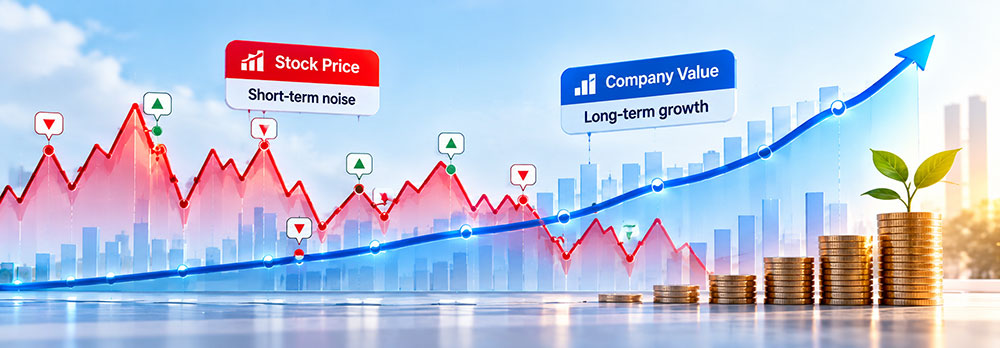
Most people would say a stock. A number that goes up and down every day, that they check first thing in the morning and again before bed. But that number is not really the thing you own. Behind every stock is a real company, with real people, real products, real customers, and real decisions being made every single day. The stock is just the price tag. The company is what actually has value.
This difference sounds small. It is not. It quietly decides how you invest, how you react to a bad week, and whether you make good decisions or panicked ones.
Two ways of looking at the exact same purchase
Say you buy shares of a company that makes packaged food.

If you are buying the stock, you are mostly watching the price. Is it going up today? Is it red this week? You compare it to what you paid, and every small move feels personal. The seven weeks of market decline we have seen recently would feel like seven weeks of bad news, because the only thing you are tracking is the number.
If you are buying the company, your questions look completely different. Are people still buying this company's products? Is the business growing, staying flat, or shrinking? Is it run well? Does it have room to grow over the next several years? A quiet week in the stock price barely registers, because you are not watching the price. You are watching the business.
Same purchase. Same company. Two very different experiences of owning it.
Why this difference matters so much
Buying the stock makes you a price-watcher. Buying the company makes you an owner.
A price-watcher reacts to noise. Every dip feels like a warning. Every rally feels like a reason to celebrate too early. An owner, on the other hand, asks a steadier question: is this business still doing what I expected it to do when I first invested? That question barely changes from week to week, even when the price does.
Buying the stock ties your mood to something you cannot control. Buying the company ties your decisions to something you actually can understand.
Nobody can predict what a stock will do tomorrow. Too many things affect it: global events, interest rates, how other investors are feeling that day. But you can understand a company. You can read about what it sells, how it earns money, whether it is expanding responsibly or taking on too much debt. That is information you can actually work with.
Buying the stock makes a falling market feel scary. Buying the company makes it feel like useful information.
Right now, the Nifty has fallen for seven weeks in a row, its longest such stretch since the COVID crash. If you are watching only the stock price, this stretch feels stressful and confusing. But if you are focused on the company, the same seven weeks raise a much calmer, more useful question: has anything actually changed about the business I own, or is this just the wider market having a rough patch that has nothing to do with my company specifically? Often, the honest answer is that nothing about the business has changed at all.
A simple way to tell which one you are actually doing
Ask yourself this question about anything in your portfolio: if the stock market shut down for a full year, with no prices to check at all, would you still be comfortable owning this company?
If your answer is yes, because you understand the business, trust how it is run, and believe in where it is headed, you are investing in a company. If your answer makes you uneasy, because without a price to watch you would have no real idea whether you made a good choice, you were probably investing in a stock.
This is not about right or wrong. Both approaches exist in the market. But owning companies tends to be the steadier, less stressful path, especially during weeks like the ones we are seeing right now.
How to shift from watching stocks to owning companies
- Read about the business, not just the price. Before buying, spend a few minutes understanding what the company actually does, how it earns money, and what could help or hurt it over the next few years. This single habit changes how you experience every future price swing.
- Check in less often, and check in on different things. Instead of opening your portfolio app daily to see the price, check in monthly or quarterly and ask about the business. Did the company's sales grow? Did anything meaningful change in its industry? This gives you a much steadier picture than a daily price ever will.
- When the market falls, ask about the company first, and the price second. A falling stock price during a wider market decline, like the seven-week fall we are in right now, does not automatically mean something is wrong with the company you own. It often just means the whole market is nervous. Separate the two questions clearly in your mind.
- Remind yourself why you bought it in the first place. If you cannot remember a real reason you chose this company beyond "the price was going up," that is worth noticing. It is a sign you may have bought the stock, not the company.
A stock price is just a number that updates every second. A company is a real business that took years to build and will likely take years to fully grow into what it can become. When you remember that you are actually buying a piece of a company, not just a moving number on a screen, the day-to-day ups and downs stop feeling like a rollercoaster and start feeling like exactly what they are: small, mostly irrelevant noise around something much bigger and steadier that you actually understand.